The global health landscape is currently being rewritten by short sequences of amino acids. Search interest in the term peptide has exploded by over 400% in recent months, fueled by a cocktail of viral success stories, “longevity” biohacking, and a desperate search for an alternative to the metabolic decay that defines modern life. We are witnessing a shift from blunt, small-molecule “hammers” to surgical “keys.” To understand the hype, you must first understand what are peptides: they are essentially signaling molecules—apps for your biological operating system.
Just as a developer uses the same base code to build a banking app or a navigation tool, your body uses amino acids as “Lego blocks” to construct varied signals. Dr. Alex Tatem notes that while the blocks are identical, their configuration determines whether you are building a “rocket ship” (recovery) or a “pirate ship” (metabolic revving). As we dive into this molecular frontier, we must navigate the tension between the “metabolic cheat code” enthusiasm of clinical researchers and the “no biological free lunch” skepticism of those who fear we are trading long-term independence for a short-term physique.
The Molecular Blueprint: Breaking Down the Peptide Bond
To grasp the power of these molecules, we must look at the cellular architecture. A peptide is a short chain of amino acids, generally defined as containing fewer than 50 units. Once a chain crosses that 50-unit threshold, it is technically classified as a protein. These units are held together by a specific covalent link known as a peptide bond. This sequence forms a polypeptide chain that acts as a targeted key, designed to fit into specific cellular locks (receptors) with a precision that synthetic pills often lack.
While the term feels futuristic, peptide therapy is over a century old. The first peptide isolated for medical use was insulin in 1921, followed decades later by Lupron (1985) for endocrine management. These are not alien substances; they are synthetic versions of endogenous molecules your body already uses to communicate. For example, the “love hormone” oxytocin and the satiety signal ghrelin are both peptides. Even well-known supplements like collagen peptides are simply hydrolyzed fragments of larger proteins, though they lack the high-level signaling power of the injectable compounds currently causing a stir in the biotech world. Understanding this distinction is vital: you aren’t just “eating protein”; you are introducing specific instructions to your cells.
- Peptide: A signaling molecule composed of a chain of <50 amino acids.
- Peptide Bond: The covalent chemical link between the carboxyl group of one amino acid and the amino group of another.
- Polypeptide: A continuous chain of amino acids linked by peptide bonds; the structural precursor to a full protein.
- Signaling Precision: Unlike small-molecule drugs, peptides act as high-affinity ligands for specific G-protein coupled receptors.
The New King of Fat Loss: Why “Reta” is Changing the Game
The evolution of peptides for weight loss has been remarkably rapid. We began with Semaglutide (Ozempic), a pure GLP-1 agonist that slows gastric emptying. We then moved to Tirzepatide (Mounjaro), a dual agonist adding GIP (Glucose-dependent insulinotropic polypeptide), which dampens the nausea of GLP-1 while mobilizing fat. Now, the industry is bracing for reta peptides, specifically Retatrutide—the “Ferrari” of the class.
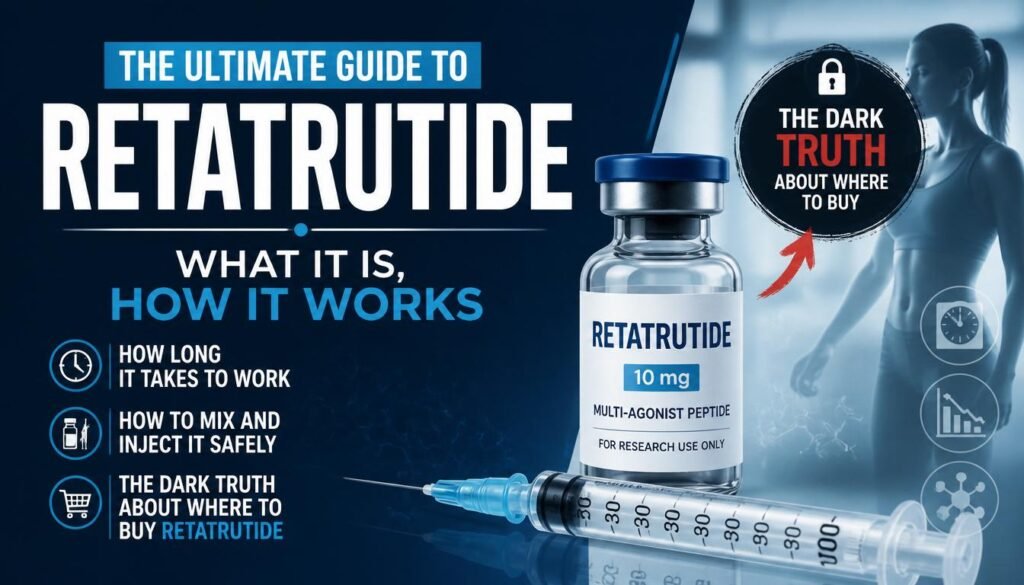
Retatrutide is a “triple agonist” (GLP-1, GIP, and Glucagon). By adding the glucagon receptor, it tricks the liver into fat-burning mode (lipolysis) while simultaneously increasing resting energy expenditure. It doesn’t just blunt hunger; it effectively “revs the engine while the car is in neutral.” The results are staggering, with weight loss reaching 25% in trials, but the ” Ferrari” comes with high-maintenance costs. Dr. Froese highlights a specific side effect called “Aladinia”—a sunburn-like skin sensitivity reported by 20% of high-dose participants. Yet, the metabolic upside is profound: Dr. Tatem reports patients seeing a 10x increase in sperm count as their metabolic dysfunction is reversed, proving that these peptides for weight loss can occasionally restore fertility by stripping away the hormonal noise of obesity.
While peptides for weight loss and muscle growth offer incredible potential, navigating the complex dosing math and safety risks can be terrifying. Clinical data shows that up to 40% of the weight you lose on these GLP-1 blends can actually be your metabolism-boosting lean muscle mass. Furthermore, FDA testing has revealed that over 40% of online “research use only” peptide products contain incorrect dosages or contaminated ingredients. To completely take the guesswork out of your journey, use our interactive Peptide Protocol & Muscle Preservation Calculator . This free tool instantly calculates your exact daily protein target to prevent muscle loss, safely measures your syringe micro-doses, and flags severe purity risks before you start.

Mitochondrial Uncoupling: Turning Fat Into Heat
Retatrutide’s true “cheat code” is mitochondrial uncoupling. Usually, our mitochondria create ATP (energy currency) from fuel. Glucagon agonism causes protons to “leak” through the electron transport chain, releasing that energy as pure heat (thermogenesis) instead of ATP. This prevents the “starvation mode” plateau where the body lowers its metabolic rate to match a caloric deficit. In contrast, Tirzepatide uses a “feudal calcium cycle”—revving a calcium pump in the cells purely to consume energy—but Retatrutide’s glucagon-driven heat production is the ultimate metabolic accelerator.
The Recovery Stack: Can Peptides Replace the Gym?
The search for the “Wolverine” factor has led many to BPC-157 and growth hormone secretagogues like CJC-1295 and Ipamorelin. BPC-157 is a synthetic version of a peptide found in human gastric juice, known for its ability to stimulate angiogenesis (new blood vessel growth). In animal models, it has spontaneously healed completely severed Achilles tendons. These are the heavy hitters for tissue repair, operating on a level of “signaling” that over-the-counter options like vital proteins collagen peptides cannot match.
However, the “Health & Biotechnology” consensus is clear: these are permissive anabolics, not magic wands. Peptides for muscle growth like CJC-1295 pulse the pituitary gland to release natural growth hormone, which aids in cellular repair and fat mobilization, but they require a physical stimulus. You cannot inject your way out of a sedentary lifestyle. Furthermore, long-term use of these secretagogues carries risks of insulin resistance or acromegaly (bone overgrowth). There is a constant tension here between the “quick fix” and the biological reality that muscle tissue requires mechanical tension to thrive.
The 40% Warning: The High Cost of Rapid Weight Loss
The most harrowing statistic in the peptide revolution is the 40% rule: up to 40% of the weight lost on GLP-1 agonists can be lean muscle mass. This “Ozempic Bod” is essentially medically-induced sarcopenia. Muscle is our primary metabolic sink; losing it tanks long-term health and bone density. To combat this, users must prioritize massive protein intake (1g per pound of lean mass) and lean into resistance training. Skeptics like Dr. Paul Saladino argue that if you are losing your “metabolic engine” (muscle) to lose the “fuel” (fat), you are losing the war.
The Gray Market Gamble: “Research Use Only” vs. FDA Reality
As the FDA cracks down, a massive gray market has filled the void. Desperate consumers are flocking to sites like apex peptides to buy vials labeled “Research Use Only.” This is “gas station sushi” for your biochemistry. An FDA study found that 40% of online peptides were either contaminated or incorrectly dosed. More alarmingly, a 2024 study of online semaglutide found purity rates as low as 7%—meaning 93% of the vial contained unknown substances.
Buying from apex peptides or similar unregulated sources bypasses the safety of 503A compounding pharmacies. These “research grade” powders often originate in overseas factories with zero oversight. When you inject a substance that is 93% “mystery juice,” you aren’t biohacking; you are playing Russian Roulette with your immune system.

Why Big Pharma Wants a Monopoly on Your Biology
The regulatory battle is heating up. Since naturally occurring sequences cannot be patented (per the 2013 Myriad Genetics case), Big Pharma is lobbying the FDA to move peptides to “Category 2,” effectively banning compounding pharmacies from producing affordable, custom versions. While they cite safety, critics point to the “Illuminati of Profit.” Interestingly, Eli Lilly is already developing “Myostatin Inhibitors” (monoclonal antibodies like bimagrumab) to solve the muscle loss problem their own weight-loss drugs created. They want to sell you the “lock” and then sell you the “key” to the side effect they caused.
Aesthetic Optimization: GHK-Cu and the Future of Skin
Beyond the metabolic and the muscular, the “copper peptide” GHK-Cu is revolutionizing aesthetics. GHK-Cu is a tripeptide with a high affinity for copper, which plays a critical role in skin regeneration. As we age, our natural levels of GHK-Cu drop significantly, leading to a decline in collagen peptides and elastin production. Unlike standard beauty creams, topical or injectable GHK-Cu has been shown in clinical settings to thicken the skin and repair the protective barrier.
While many consumers spend hundreds on commercial collagen peptides that are mostly digested as simple protein, GHK-Cu acts as a signal to the skin’s fibroblasts to “wake up” and begin the repair cycle. It’s the difference between sending more bricks to a construction site (supplemental collagen) and hiring a foreman to start the work (GHK-Cu).
[INSERT IMAGE 2: Visual comparison of skin cell regeneration before and after peptide stimulus]
Conclusion: Is There a Biological Free Lunch?
The “No Free Lunch” philosophy is the most vital takeaway of the peptide era. Every potent upside—be it the fat-burning power of reta peptides or the recovery speed of BPC-157—carries a trade-off. We must ask: are we creating a lifelong dependency on Big Pharma’s “molecular keys”? Dr. Saladino’s warning that we are “poisoned by ultra-processed food and then fixed by pharmaceutical companies” rings true for many.
Peptides are incredible tools for optimization, but they are not a replacement for the foundational pillars of health: real food, sunlight, and movement. If you choose to use them, do so with a physician’s guidance, a focus on muscle preservation, and a healthy dose of skepticism regarding the unregulated gray market.
The Ultimate Peptide Blueprint (Summary Table)
| Peptide | The “Lock” (Target) | The “Result” (Benefit) | Potential Trade-off |
| BPC-157 | Gastric Lining / VEGF | Rapid tissue and tendon repair. | Theoretical risk of cancer via excess angiogenesis. |
| Retatrutide | GLP-1, GIP, & Glucagon | “Ferrari” fat loss & thermogenesis. | Increased heart rate (5-10 bpm) and Aladinia. |
| GHK-Cu | Skin Fibroblasts | Enhanced skin elasticity and elastin. | Requires specific titration to avoid copper imbalance. |
| CJC-1295 | Pituitary Gland | Pulsatile growth hormone release. | Risk of insulin resistance if not cycled correctly. |